For 30 years, the Jacob and Wilhelm Grimm Prize has been honouring outstanding scholars in German studies – raising awareness and creating opportunities.
Text: Hendrik Bensch
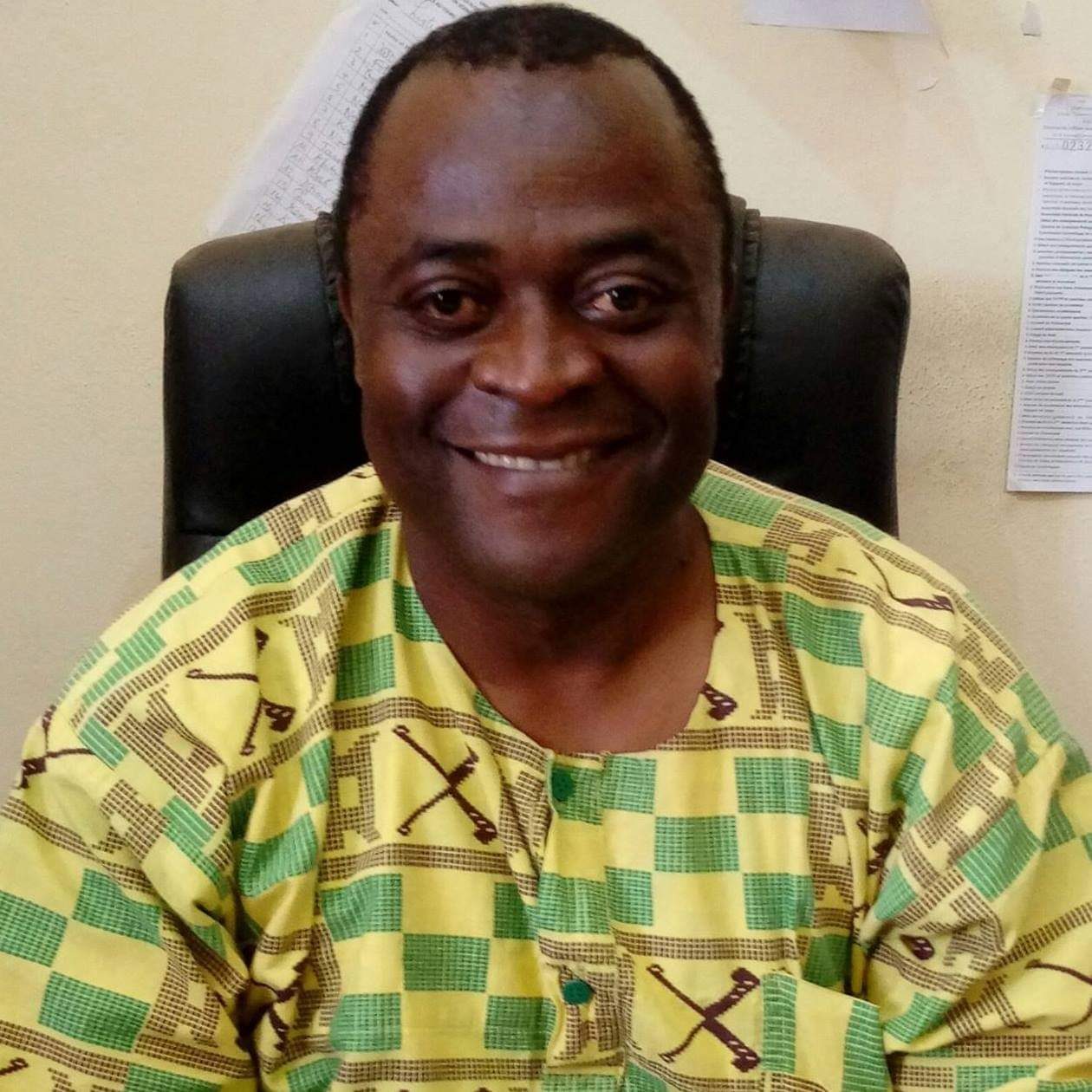
Professor Albert Gouaffo sometimes finds studying the remnants of German colonial history rather painful. He admits that German museums and archives are now on the right track when it comes to addressing the country’s colonial heritage. “However, whenever I enter museum storerooms, they still seem like cemeteries to me. During the colonial era, many objects were removed from their social and spiritual context and thereby stripped of their symbolic significance.”
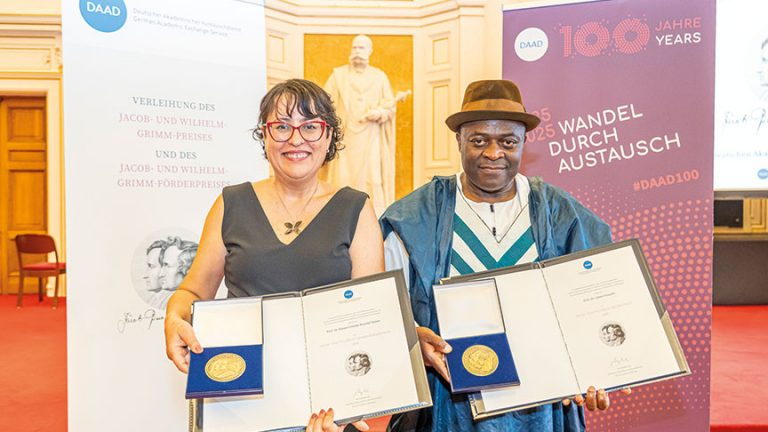
In a joint project with the art historian and DAAD alumna Professor Bénédicte Savoy, he has compiled an “Atlas of Absence”. For the first time, it systematically documents more than 40,000 cultural assets from Cameroon that to this day languish – largely ignored – in German museum storerooms. This is just part of the wide-ranging work for which the Cameroonian literary and cultural studies scholar was awarded this year’s Jacob and Wilhelm Grimm Prize.
“What sets the prize winners apart is the way they use extensive international networks to build bridges for academic exchange and for the future of German studies.”
Dr Muriel Helbig, DAAD Vice President
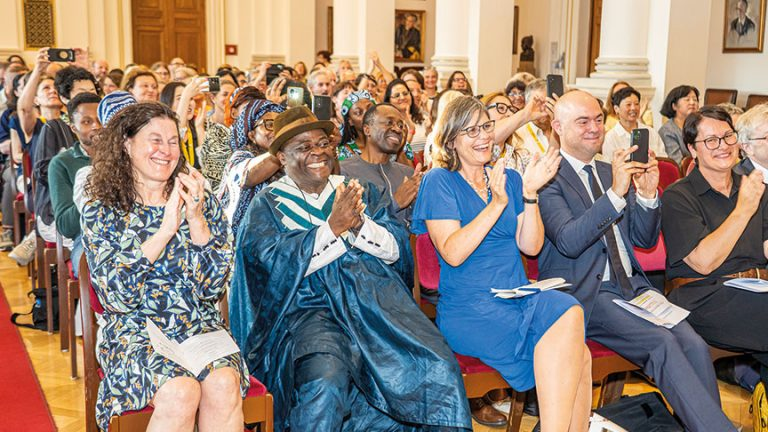
For 30 years, the DAAD has been presenting this prize to international scholars for their outstanding work in German literary studies and linguistics, German as a foreign language and German studies. It pays tribute to those whose teaching and research activities abroad have particularly contributed to international academic cooperation and cultural understanding. This year’s prize was awarded during the Congress of the International Association for Germanic Studies in the Austrian city of Graz. In her welcome speech, DAAD Vice President Dr Muriel Helbig emphasised the important role that prize winners play – not only in their specialist fields: “What sets the prize winners apart is the way they use extensive international networks to build bridges for academic exchange and for the future of German studies.”
Albert Gouaffo, this year’s winner, studied at Saarland University, where he also obtained his PhD and qualified as a professor. He has been a professor at the University of Dschang in Cameroon since 2006. With a broad range of publications in German, French and English under his belt, he promotes intercultural German studies and critical analysis of the period of German colonial rule in Cameroon. As founder of a German studies journal and vice president of the association German Studies in sub-Saharan Africa, he is also committed to establishing networks of German studies experts on the African continent. He believes it is important for German studies not to be an isolated discipline: “It must retain its social relevance, for example by contributing to a critical analysis of colonial history, promoting intercultural skills or creating space for social self-reflection.”
However, it is not only the prize winners’ projects that have an impact. The Grimm Prize itself brings about change. “When I was awarded the prize, it positively influenced our subject’s development in Romania,” reports Professor Andrei Corbea-Hoişie, winner of the prize in 2000. “I suspect that its symbolic significance also helped elevate the status of all the country’s Germanists in the eyes of German and foreign colleagues.” Professor Yixu Lü, who won the prize in 2014, takes a similar view: “I see the Grimm Prize as an indispensable means of promoting German studies. The prize makes its international importance visible and sends a strong signal for its future.” As well as a cash prize, winners are also given the opportunity to spend a period of time conducting research in Germany.
Since 2011, the DAAD has awarded the Grimm Young Talents Award, which is likewise funded by the Federal Foreign Office, to young international Germanists who have already rendered visible services to the study and teaching of German language, literature and culture. This year’s award went to Dr Elaine Cristina Roschel Nunes from Brazil, who trains future German teachers at Brazil’s Universidade Federal de Santa Catarina.
For her doctoral thesis, she created a mentoring programme for trainee teachers. The programme fosters collaboration between students, lecturers and experienced teachers who learn together on an equal footing. The idea is for mentees to reflect on their classroom experiences, formulate hypotheses and develop their own teaching style. “The goal is to encourage participants to come up with their own ideas and methods, drawing on their personal experience and tailored to the environment in which they teach – rather than simply adopting set concepts they have been given,” she says. Her approach is already being practised in a project being conducted at Santa Catarina University’s language centre in Brazil. In future, cooperation with local schools is also planned.