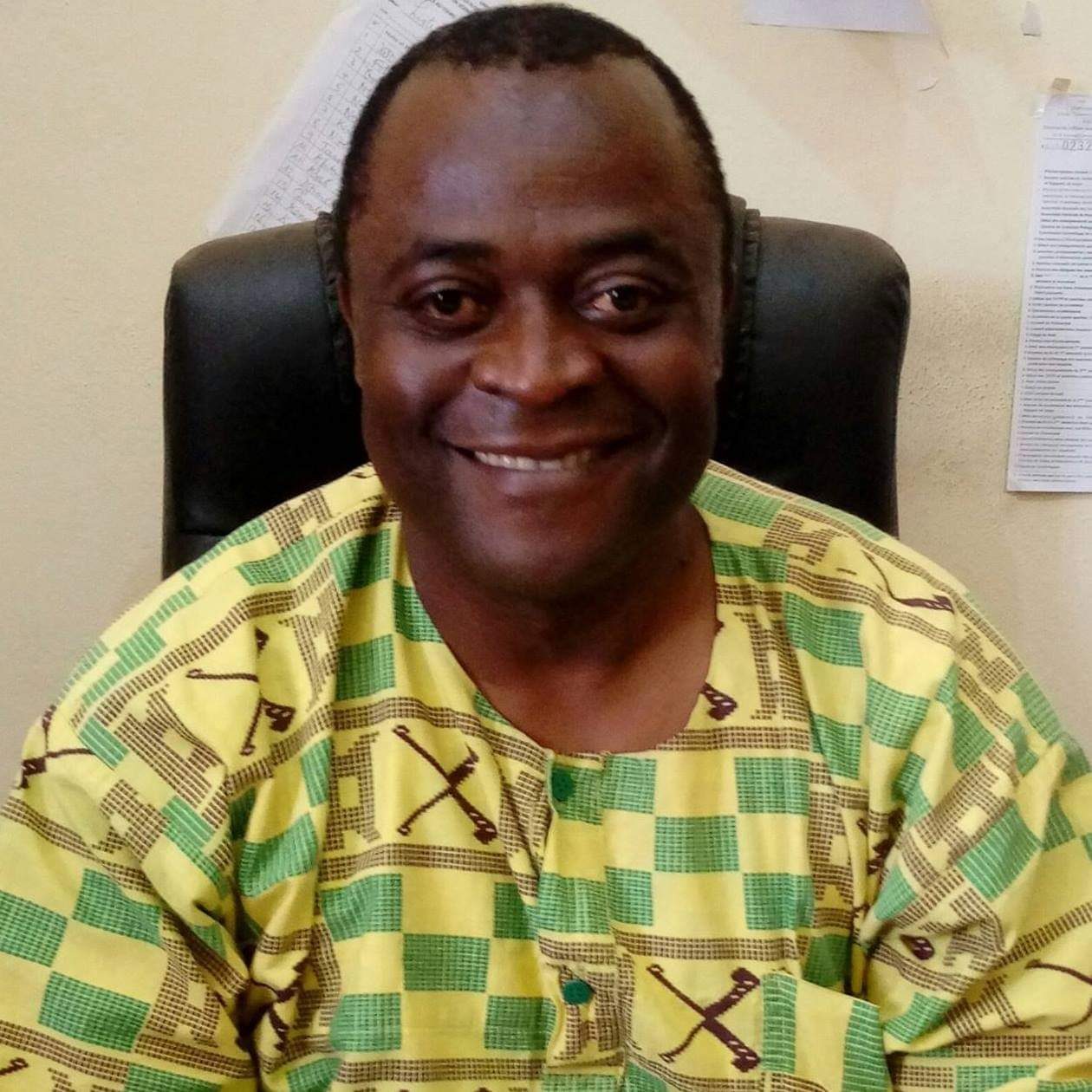
Deutsche Museen haben den größten Bestand kamerunischer Kunst- und Kulturgegenstände weltweit. Sie sind häufig kontextlos in den Ausstellungsräumen großer ethnologischer Museen zu sehen oder liegen vergessen in deren Kellerräumen. Prof Dr. Albert Gouaffo erzählt, wie sie dort hingelangt sind und warum sich deutsche Museen mit Rückgaben immer noch schwertun.
Rund 40.000 kamerunische Kulturgüter befinden sich in Kellern und Ausstellungsräumen deutscher Museen. Wie sind diese dorthin gelangt?
Die Kulturgüter sind von Missionaren, von Kolonialbeamten, von sogenannten Forschungsreisenden sowie deutschen Soldaten ab 1884 nach Deutschland gebracht worden. In Deutschland haben sie den Museen die Objekte geschenkt oder verkauft.
Viele dieser Gegenstände stammen aus den Palästen von Königen oder mächtigen Familien aus Kamerun. Sie wurden von deutschen Soldaten als Kriegstrophäen nach Deutschland gebracht. Sie wurden also im Zuge gewaltsamer, kriegerischer Handlungen durch die Deutschen entwendet – allgemein kann man von Plünderungen sprechen.
40.000 Gegenstände ist zudem nur eine ungefähre Zahl. Denn in unsere Forschung konnten wir bislang nur 45 Museen deutschlandweit berücksichtigen – es gibt aber noch weitere Museen in Deutschland, in deren Beständen sich Objekte aus Kamerun befinden. Außerdem haben wir auch Privatsammlungen, den allgemeinen Kunstmarkt oder auch Missionsmuseen noch nicht untersucht.
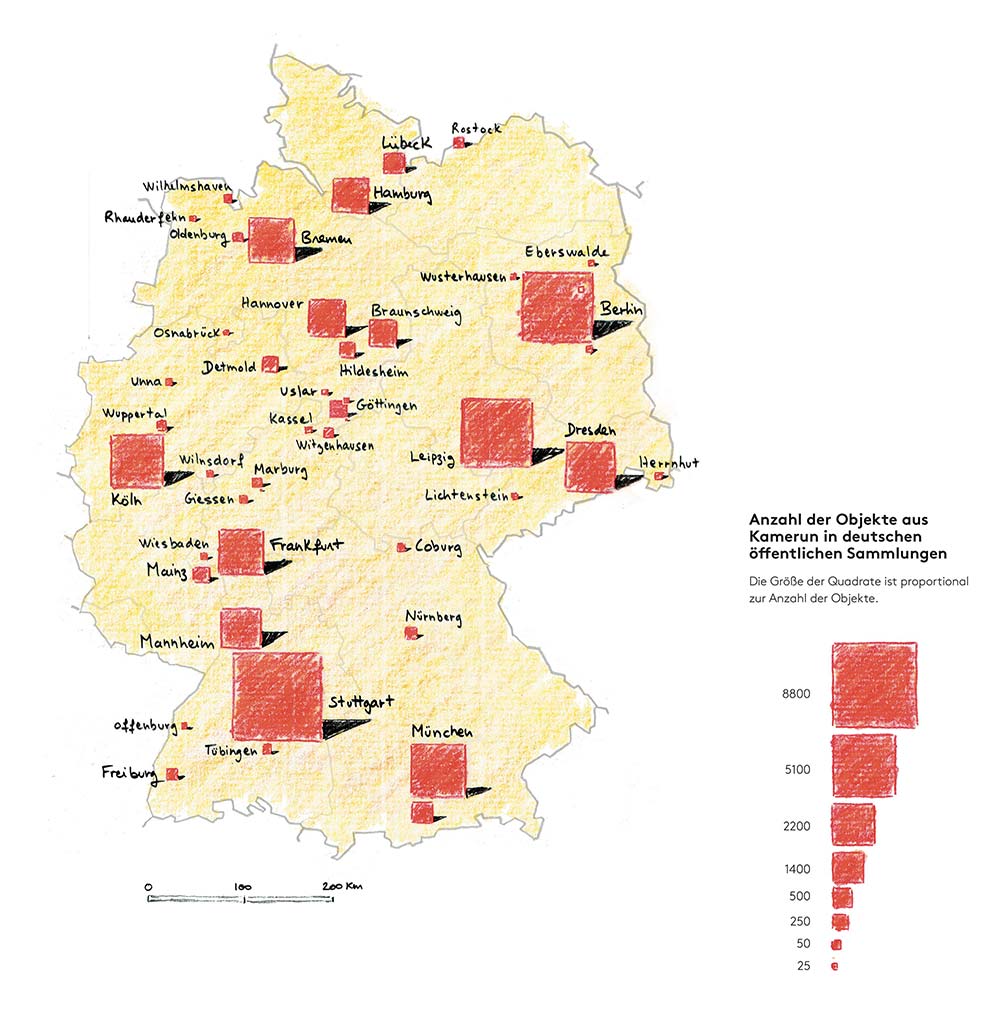
© Rekacewicz, Philippe (2023): Anzahl der Objekte aus Kamerun in deutschen öffentlichen Sammlungen. Die zugrunde liegenden Daten aus dem DFG-Projekt »Umgekehrte Sammlungsgeschichte«: Sprute, Sebastian-Manés (2023): Dislokation des kamerunischen Kulturerbes in Zahlen. In: Autor:innenkollektiv. Andrea Meyer und Bénédicte Savoy (Koord.) Atlas der Abwesenheit. Kameruns Kulturerbe in Deutschland. Berlin: Dietrich Reimer Verlag, S. 44-45.
Sie sprechen allgemein von Plünderungen durch Deutsche in Kamerun. Trotzdem scheint es häufig schwierig nachzuweisen, dass diese Kulturgüter geplündert oder geraubt wurden. Warum ist das so?
Ich glaube nicht, dass es schwierig ist, nachzuweisen, dass der Großteil dieser Kulturobjekte geraubt wurde. Ein Großteil der Gegenstände fällt unter die Rubrik Kriegsbeute, das lässt sich durch Quellen nachweisen. Auch wenn vielleicht nicht bei allen Gegenständen in schriftlichen Quellen steht: Der Soldat xy hat das bestimmte Objekt entwendet, so sind doch die Quellen zu den allgemeinen Kriegshandlungen bekannt. Und das reicht schon, das ist schon genug, um zu belegen, dass die Gegenstände unter unfairen Umständen oder in Unrechtkontexten mitgenommen worden sind.
Museumsleitungen sind immer noch unwillig, Kulturgüter zurückzugeben, da ihre Existenz als Institution auf diesen Sammlungen beruht. Und sie verschanzen sich hinter Gesetzestexten. Man sagt einfach, es steht im nationalen Recht, dass Kriegsbeute auch zum nationalen Gut zu zählen ist. Aber im Kontext von kolonialer Kriegsbeute, denke ich, muss man das auf andere Weise angehen. Zunächst müsste die Sprache der Museen dekolonisiert werden. Also wenn man von Geschenk spricht, dann denkt man eigentlich nur an denjenigen, der das geraubte Kulturgut den Museen übergeben hat. Also man geht nicht bis in die Herkunftsländer, um zu fragen, wie der deutsche Träger, der Akteur, der das Geschenk gemacht hat, wie er überhaupt in Besitz des Gegenstandes gekommen ist. Ich denke, aus wissenschaftlicher Sicht müsste die Provenienzforschung zudem nicht in Deutschland stehen bleiben. Vielmehr müssen wir eine umgekehrte Provenienzforschung betreiben, so wie wir das für einige Objekte bereits im „Atlas der Abwesenheiten“ begonnen haben. Das heißt, zurück in die Herkunftsgesellschaften schauen, zunächst Informationen über die Biografie der Objekte einholen und prüfen, wie diese Objekte seinerzeit nach Deutschland kamen. Derzeit wird die Frage immer noch häufig aus der falschen Perspektive behandelt: Nicht die Herkunftsregionen sollten beweisen müssen, dass Dinge entwendet wurden. Nein, Deutschland muss sich fragen, wie es sein kann, dass so viele Objekte aus anderen Ländern in ihren Museen liegen und sollte beweisen, dass die Kulturgüter in den Herkunftsländern legitim erworben wurden.
Forderungen nach Rückgaben von Kulturobjekten gibt es von afrikanischen Akteur:innen schon seit den siebziger Jahren. Wieso haben Museen in Deutschland sich diesen Forderungen gegenüber so lange verschlossen gezeigt?
Grundsätzlich waren und sind Museen immer Orte der Macht und der Repräsentanz von Macht. Und wer Museen leert, der verliert einen Teil seiner Macht. Außerdem haben die Kulturgüter zum Teil einen sehr hohen Marktwert; sie sind sehr wertvoll. Anfang der 70er Jahre haben Museumsdirektoren eine Strategie entwickelt, um Rück- und auch Leihgaben an die Herkunftsländer zu unterbinden. Und diese Strategie beruhte darauf zu sagen, dass Deutschland keine problematischen Erwerbungen hat, weil die Museen die Objekte legal über den Kunstmarkt oder von Offizieren erworben oder geschenkt bekommen haben. Die Museums- und Stiftungsdirektoren haben Bemühungen um Restitution damals erfolgreich unterbunden.
Aber die Büchse der Pandora ist jetzt offen, und es gibt keinen Weg mehr zurück wie in den siebziger Jahren. Jetzt ist es bekannt, dass die meisten Kulturgüter aus Kamerun in Deutschland liegen. Jetzt haben wir selbst als Betroffene die Forschung gemacht, und wir wissen jetzt, was in den Kellern steckt und wo das steckt. Und es gibt keinen anderen Weg als zu verhandeln. Übrigens ja nicht nur über Kulturobjekte, sondern auch über das, was man heute menschliche Überreste nennt. Das war ja auch Teil der Kriegsbeute und liegt auch immer noch in Deutschland. Als Kriegsbeute wurden Leichen und Schädel von Widerstandskämpfern, aber auch von ganz normalen Zivilisten für anthropologische Sammlungen und Forschungen nach Deutschland geschickt. Im Rahmen meines Forschungsaufenthalts war ich auch in Freiburg, wo die Schädel von fünf Widerstandskämpfern der Makaa, einer Community im Südosten Kameruns, immer noch in den Archiven der Universität liegen.
Archive besuchen, Kulturgut erforschen und sichtbar machen, das sind wichtige Bestandteile Ihrer Arbeit. 2022 wurden aber einer Person aus Ihrem Forschungsteam das Visum für einen Aufenthalt in Deutschland verwehrt. Sie haben das als institutionellen Rassismus bezeichnet. Können Sie das ausführen?
Wir waren zu einem Forschungsprojekt des Museums Fünf Kontinente in München eingeladen. Und meiner Doktorandin wurde das Visum verwehrt. Sie war bereits zuvor in München gewesen und war nun zum zweiten Mal Teil der Forschungsgruppe. Sie hatte alle Papiere parat, die sie bei der ersten Reise vorgelegt hatte. Doch diesmal lehnte die deutsche Botschaft das Visum mit der Begründung ab, es bestünde die Möglichkeit, da sie nicht verheiratet sei und keine Kinder habe, dass sie in Deutschland bleiben würde. Ich habe mich gefragt, könnte das einer US-Amerikanerin oder einer Kanadierin passieren, die in diesem Kontext reisen möchte? Meine Antwort ist nein, das ist unmöglich. Das zeigt, wie institutionell und verwaltungsmäßig Rassismus auf höchster Ebene durchgeführt wird.
Ich erlebe das im Übrigen auch als Forscher selbst – es gibt immer noch deutsche Kollegen, die versuchen, einem ihre Meinung aufzuzwingen. Da werden koloniale Verhältnisse weiter reproduziert.
Prof Dr. Albert Gouaffo ist Literatur- und Kulturwissenschaftler an der Universität Dschang in Kamerun. Gemeinsam mit der Kunsthistorikerin Prof. Dr. Bénédicte Savoy von der TU Berlin leitete er von 2020 – 2023 das Forschungsprojekt „Umgekehrte Sammlungsgeschichte. Kunst und Kultur aus Kamerun in deutschen Museen“.
In der Projektpublikation „Atlas der Abwesenheiten Kameruns Kulturerbe in Deutschland“ wird erstmalig die unsichtbare Präsenz kamerunischer Kulturgüter in deutschen Museen intensiv aufgearbeitet und die Folgen des Fehlens dieser Dinge in Kamerun dargestellt.
Link zur Projektpublikation
Link zur Arte-Dokumentation